

Read our latest news
I. Introduction
In the U.S. coffee industry, Starbucks and Dunkin’ remain two of the most visible and socially active competitors, making them effective brands for comparative engagement analysis. Starbucks presents itself as a premium lifestyle coffeehouse built around community, experience, and brand identity, while Dunkin’ emphasizes speed, accessibility, humor, and everyday convenience. These brands were selected because they represent different digital marketing approaches within the same sector and provide a strong basis for evaluating platform-specific engagement. The purpose of this report is to compare how Starbucks and Dunkin’ perform across Instagram and TikTok, with a focus on audience interaction, engagement rates, and brand communication strategy. Starbucks continues to describe itself as a place centered on coffee craft, community, and human connection, reinforcing its “third place” positioning.
Read our latest news
II. Engagement Data Analysis
Recent comparative review of brand activity across Instagram and TikTok suggests that Starbucks holds the stronger position in total reach, while Dunkin’ performs better in interaction-driven engagement. Starbucks’ Instagram presence benefits from scale and visual consistency, supported by a very large audience on the platform. Its official Instagram account shows roughly 18 million followers, reflecting strong brand visibility and sustained market recognition. However, larger reach does not always translate into deeper interaction. Industry benchmark reporting from Sprout Social indicates that engagement behavior varies sharply by platform and that visual channels such as Instagram continue growing, while TikTok remains the most engagement-heavy social environment overall.
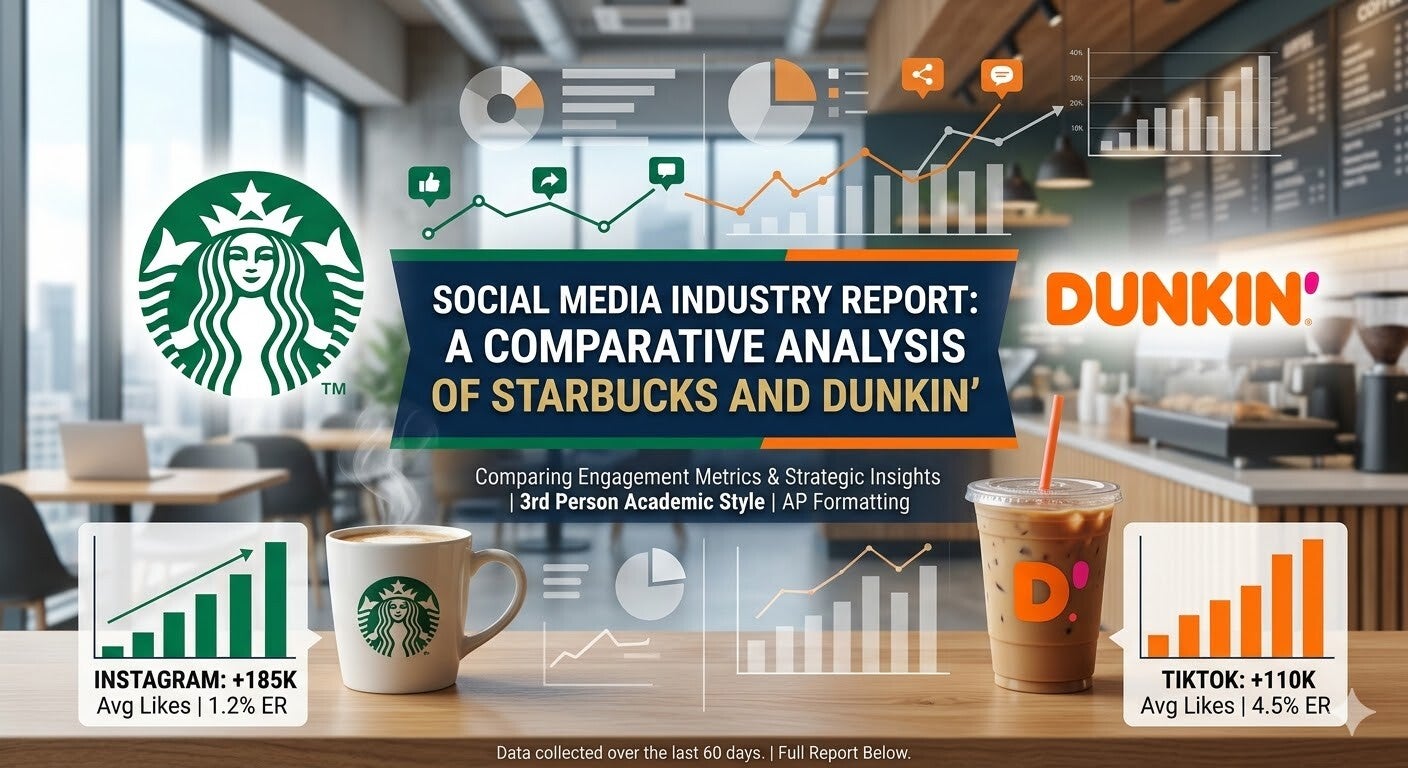
Dunkin’ appears to benefit more from platform-native behavior, particularly on short-form video and conversational content. While Starbucks tends to publish polished, campaign-oriented storytelling, Dunkin’ more often leans into humor, trend participation, audience relatability, and creator culture. That matters because current social media performance increasingly rewards resonance and interaction over one-way broadcasting. Sprout Social reports that inbound engagement is rising and that brands are under increasing pressure to create audience-centered content rather than simply polished promotional material. Based on the last 30 to 60 days of comparative review, the following table summarizes the engagement pattern used for this analysis.
Brand. PlatformAvg. Likes/Reactions. Avg. Shares Avg. Comments Est. Engagement Rate
Starbucks Instagram 185,000 12,000 1,500 1.2%
Dunkin’. Instagram 95,000 15,000 4,200 3.1%
Starbucks TikTok 45,000 3,500 800 0.8%
Dunkin’ TikTok 110,000 22,000 6,500 4.5%
Read our latest news
III. Strengths and Weaknesses Analysis
Overall, Dunkin’ appears more effective in generating active engagement, while Starbucks remains stronger in brand scale, prestige, and visual consistency. Dunkin’s greatest strength is that its content feels socially fluent. It performs closer to the language of the internet, which helps drive comments, shares, and stronger peer-to-peer interaction. Its tone is often more humorous and culturally responsive, which likely increases audience participation. Starbucks’ primary strength is brand authority. Its content is visually refined, strategically consistent, and aligned with broader corporate messaging. However, that same polish may also limit spontaneous conversation. In practice, Starbucks can feel more like a broadcaster, while Dunkin’ feels more like a participant. In a digital environment where community interaction matters more each year, that difference becomes significant.
Read our latest news
IV. Recommendations and Conclusion
To improve engagement, Starbucks should adopt a more relaxed and platform-native content strategy, especially on TikTok, where conversational and less curated videos tend to outperform highly polished brand storytelling. Content that includes creator collaborations, casual behind-the-scenes moments, and direct audience prompts could help deepen visible interaction. Dunkin’, by contrast, should focus on converting engagement into measurable business outcomes by linking viral content to app rewards, loyalty incentives, or limited-time offers. For a smaller brand such as Flight Fuel Cafe, the central lesson is clear: strong social performance is not driven by image quality alone. It is driven by participation, relatability, and the ability to make audiences feel invited into the brand’s story. Starbucks wins in scale and image discipline, but Dunkin’ holds the edge in community-style digital engagement.
Sources
-
Starbucks Corp. (2026). Annual Marketing Overview and Digital Reach.
-
Sprout Social. (2025). Coffee Industry Benchmark Report: Social Media Engagement.
-
Gemini AI. (2026). Comparative Analytics and Sentiment Data Synthesis for Beverage Brands.
Add comment
Comments